
Custom Paper Bags for Branding: Which Style Fits Your Product Best?

Choosing custom paper bags for branding starts with the product, not the artwork. A bakery item, a skincare set, and a wine bottle place different demands on paper stiffness, bottom support, handle attachment, and surface treatment. The bag needs to carry the product without losing shape while leaving enough clean surface for logos, colors, and finishing details.
Kingever Technology has worked in packaging production since 2001. Its integrated workflow covers printing, die-cutting, lamination, hot stamping, bag making, inspection, and packing. This allows paper weight, surface finish, handle construction, reinforcement, and sample approval to be considered within the same packaging specification rather than treated as separate design decisions.

What Should You Compare before Choosing Custom Paper Bags?
Before selecting a style, define what the bag must do after it is filled. Appearance matters, but bag size, paper stiffness, handle structure, and the packed product usually determine whether the design works in actual retail use.
Product Weight and Carrying Requirements
Start with packed product weight and dimensions. Kingever uses 200g, 230g, and 250g paper options across several shopping-bag ranges. Lighter paper can suit samples, stationery, small cosmetics, or lightweight food products, while heavier paper provides more stiffness for gift sets, bottles, health products, and other products that put more load on the bag structure.
For wholesale custom paper bags, paper weight alone should never be the final purchasing criterion. Bag width, gusset depth, bottom area, top fold, and handle attachment all affect how the load travels through the structure.
A physical sample should therefore be tested with the actual product inside it.
Brand Positioning and Visual Presentation
Kraft provides a more visible paper character and works naturally with understated, organic, or craft-oriented packaging. White kraft creates a cleaner printing surface while retaining the simpler appearance associated with kraft packaging. Specialty paper adds texture and tactile differentiation, while white cardboard provides a flatter surface for detailed printed artwork.
Custom paper bags with logo should also match the primary packaging. If the product already uses a highly decorative gift box, the carrier bag may only need restrained branding. If the product packaging is simple, foil, texture, or a more distinctive handle can give the outer carrier more visual responsibility.
Printing, Finish, and Handle Choices
Kingever supports foil stamping, UV treatment, lamination, reinforced paper-rope handles, polyester webbing, and metal-rivet reinforcement.
A small cosmetic bag may only require a paper-rope handle and printed logo. A bottle or heavier gift places more force around the handle fixing points, so reinforcement around the folded top edge becomes more relevant.
For custom paper bags with logo, approve logo size, finish area, paper color, handle color, and handle fixing method together. A handle that looks appropriate on an empty sample may behave differently once the bag is loaded.
Which Paper Bag Material Fits Your Product Best?
Once functional requirements are clear, material becomes the main visual and structural decision. There is no reason to specify the heaviest stock for every project; paper should be matched to product weight, bag dimensions, artwork, and desired hand feel.
Multi-Colored and White Kraft for Natural or Minimalist Branding
Custom printed kraft paper bags suit brands that want the paper itself to remain visible as part of the packaging style. The range includes 200g, 230g, and 250g options, allowing the same general material direction to cover lightweight retail goods as well as larger gift applications.
For a cleaner visual base, white kraft paper bags use the same 200g, 230g, and 250g progression. They can suit skincare, tea, stationery, takeaway retail, and gift packaging where a lighter-colored surface gives printed graphics more visual separation from the substrate.
The choice between custom printed kraft paper bags and white kraft paper bags should therefore be based on branding direction first, then checked against stiffness and carrying requirements.
Specialty Paper for Premium Retail and Gift Presentation
Custom specialty paper bags fit projects where surface texture is part of the customer experience. Options include textured, fabric-like, pearlescent, checked, and other specialty paper surfaces, with 200g, 230g, and 250g weights available.
This direction can suit fragrance, cosmetics, jewelry, fashion, coffee, hotel gifts, and other products where the outer packaging is expected to contribute to the presentation rather than simply transport the item.
Custom specialty paper bags should still be tested with the real product. Texture affects appearance and touch, but it does not replace correct bag dimensions, bottom support, or handle reinforcement.
White Cardboard for Structure and High-Definition Printing
White cardboard shopping bags suit projects that need a straighter profile and a smooth white surface for detailed printing. Kingever offers 200g, 230g, and 250g options, with lamination, foil, and UV treatments available.
For cosmetics and lightweight gifts, a lower paper weight may provide sufficient structure. Gift sets, beverages, and larger products may justify moving upward in paper weight to reduce panel flex.
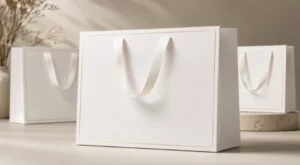
White cardboard shopping bags are particularly relevant when accurate graphics and a clean bag silhouette have more value to the brand than visible kraft texture.
Which Bag Style Works Best for Different Product Categories?
Product category often narrows the material decision quickly. The main question is not simply what the product is, but how much it weighs, how consumers carry it, and whether the bag is part of gifting, everyday retail, or longer-distance handling.
Food, Bakery, Tea, and Everyday Retail
For bakery items, tea, stationery, samples, and everyday retail goods, kraft or white kraft often provides enough flexibility without unnecessary material weight.
Custom printed kraft paper bags suit natural or seasonal graphics, while white kraft paper bags make sense where cleaner color reproduction matters more.
If food will touch the bag directly, food-contact requirements should be confirmed separately from the structural shopping-bag specification.
Cosmetics, Fashion, Jewelry, and Premium Gifts
Cosmetics and fashion packaging often works best when the shopping bag continues the design language of the primary product box.
Custom specialty paper bags can introduce texture without requiring heavy ink coverage, while white cardboard can support finer graphics and a more defined outer shape. Handle selection should then follow the real packed weight rather than being chosen only from a visual sample.
Wine, Beverages, and Heavier Products
Heavier products require the load path to be considered from the handle down to the bottom panel. A 250g paper body can increase stiffness, but paper weight alone does not prevent handle tearing or bottom sagging.
For retail bags intended to carry glass bottles at approximately 3–6 kg static load, the top edge can be reinforced with an internal 300–400 gsm white cardboard strip folded into the cuff area. This spreads force away from the handle eyelets instead of concentrating the full load on the outer paper wall.
The bottom also needs its own reinforcement. A 350–450 gsm die-cut greyboard bottom card, fixed inside the base with industrial hot-melt adhesive, helps distribute the product weight across a wider area and reduces local bending around bottle bases or other concentrated loads.
Kingever’s 250g white kraft, specialty paper, and white cardboard options can therefore be treated as different visual directions rather than complete load-bearing specifications by themselves.
For projects close to the 3–6 kg range, reinforced webbing, rivet fixing, top cuff reinforcement, and bottom board should be reviewed as one structure. Static-load figures should also not replace physical carrying tests. Walking, lifting, sudden stops, and repeated handling create short dynamic forces above the simple resting load.
For wholesale custom paper bags carrying bottles, load the finished sample with the actual products and check four points:
- whether the handle holes or riveted areas begin to deform;
- whether the reinforced top edge stays flat;
- whether the bottom card remains level instead of bowing;
- whether gussets and glued seams maintain their shape during repeated lifting.
This type of loaded sample test provides more useful purchasing information than simply comparing paper grammage.
What Should B2B Buyers Confirm before Bulk Ordering?
Bulk production should begin only after dimensions, material, reinforcement, finish, and carrying requirements have been aligned. A technically correct sample reduces the chance of discovering structural problems after thousands of bags have already been produced.
Size, Paper Weight, and Real-Product Fit
Provide packed product dimensions, total weight, expected order quantity, preferred bag size, and normal carrying method.
Test a sample with the actual contents. Check the base, gussets, top opening, handle clearance, reinforcement, and how the bag stands when loaded.
For custom paper bags, this prevents two common purchasing errors: selecting a bag that is visually oversized for the product or increasing paper weight while leaving weak handle and bottom structures unchanged.
Artwork, Color, Finish, and Handle Samples
Review color and finish on the selected paper rather than on a generic proof. Natural kraft, white kraft, specialty paper, and white cardboard receive color differently.
Kingever uses digital proofing, spectrophotometer-based color checking, offset printing, UV processing, hot stamping, lamination, and automatic bag-making equipment within its production workflow.
If foil, UV, lamination, ribbon, paper rope, webbing, rivets, top reinforcement, or bottom cards form part of the final specification, these details should be present on the approved physical sample.
Production, Inspection, and Shipping Details
A practical order sequence includes requirement confirmation, quotation and order placement, sample confirmation, production scheduling, manufacturing, inspection, packing, warehousing, and shipment. After the preceding confirmation stage, production scheduling begins within seven days in Kingever’s process.
Before release, agree on inspection points for dimensions, print position, bag forming, handle attachment, reinforcement, surface finish, and carton packing.
Shipping timing should still be confirmed against actual order quantity, material, finishing processes, and destination rather than treated as a fixed figure for every project.
How Can Kingever Support a Custom Paper Bag Project?
A bag project becomes easier to control when paper, reinforcement, print, finish, and inspection are treated as parts of one production specification rather than separate purchasing items.
One-Stop Customization from Sampling to Mass Production
Kingever’s facility covers prepress proofing, printing, hot stamping, lamination, die-cutting, bag making, inspection, packing, and warehousing.
Buyers can compare 200g, 230g, or 250g paper and then evaluate whether handle reinforcement, top cuff inserts, bottom cards, or different finishing processes are required before the final artwork and production specification are locked.
Paper Bag Options for Different Brand Positions
The full custom paper shopping bags range provides four useful starting directions:
- Multi-colored kraft for visible paper character and flexible branding;
- White kraft for a cleaner but still relatively natural presentation;
- Specialty paper for texture-led retail and gifting;
- White cardboard for defined structure and detailed printed graphics.
The final decision should always return to product weight, bag size, load distribution, handle system, and intended retail use.
Service and Contact for Samples and Quotes
If a project is difficult to specify from artwork alone, prepare the product dimensions, packed weight, expected order quantity, preferred paper, surface finish, handle type, reinforcement requirements, and destination market. Kingever can then compare suitable structures, define what should be included in the physical sample, and clarify production requirements through its contact channel before the final specification is approved.
FAQ
What Paper Weight Should I Choose for Custom Paper Bags?
Use product weight, bag size, and reinforcement structure together. Kingever works with 200g, 230g, and 250g options across several ranges. Lightweight products may not need the stiffness of the heaviest paper, while bottles and larger gift sets can require heavier paper plus reinforced handles, top folds, and bottom support. A loaded physical sample should confirm the final selection.
Are Kraft or White Paper Bags Better for Branding?
Neither material is automatically better. Kraft keeps more visible paper character, while white kraft and white cardboard provide a cleaner background for printed colors and detailed graphics. The better fit depends on brand style, product category, surface finish, and carrying load.
What Information Should I Send before Ordering Custom Paper Bags?
Send product dimensions, packed weight, required bag size, order quantity, artwork, paper preference, finish, handle type, reinforcement requirements, and destination market. For custom paper bags carrying heavier products or using special finishes, approve a physical sample so color, folding, top reinforcement, handle attachment, bottom support, and actual carrying performance can be checked before mass production.